

R&D investment grew by nearly 12% in Q4 of 2020

Research and development expenditure grew dramatically in Q4 of 2020—by nearly 12% compared with Q3. However, just three sectors accounted for most of that growth: pharmaceuticals, biotechnology & medical research, and software & IT services.
Excluding these three sectors, R&D expenditure still increased, but at a more modest pace of around 3.5%.

In the Pharmaceutical sector alone, R&D expenditure increased by an estimated $7 billion. Some of this increase is attributable to large pharmaceutical firms’ seeking to bring COVID-19 vaccines and therapies to market through acquisitions and expansion of clinical trials.
Other sectors that saw significant growth (in percentage terms) include:
- Automobiles & Auto Parts
- Leisure Products
- Chemicals
- Professional & Commercial Services
- Healthcare Equipment & Supplies
Each of these sectors’ investment in R&D is now significantly above pre-COVID levels.
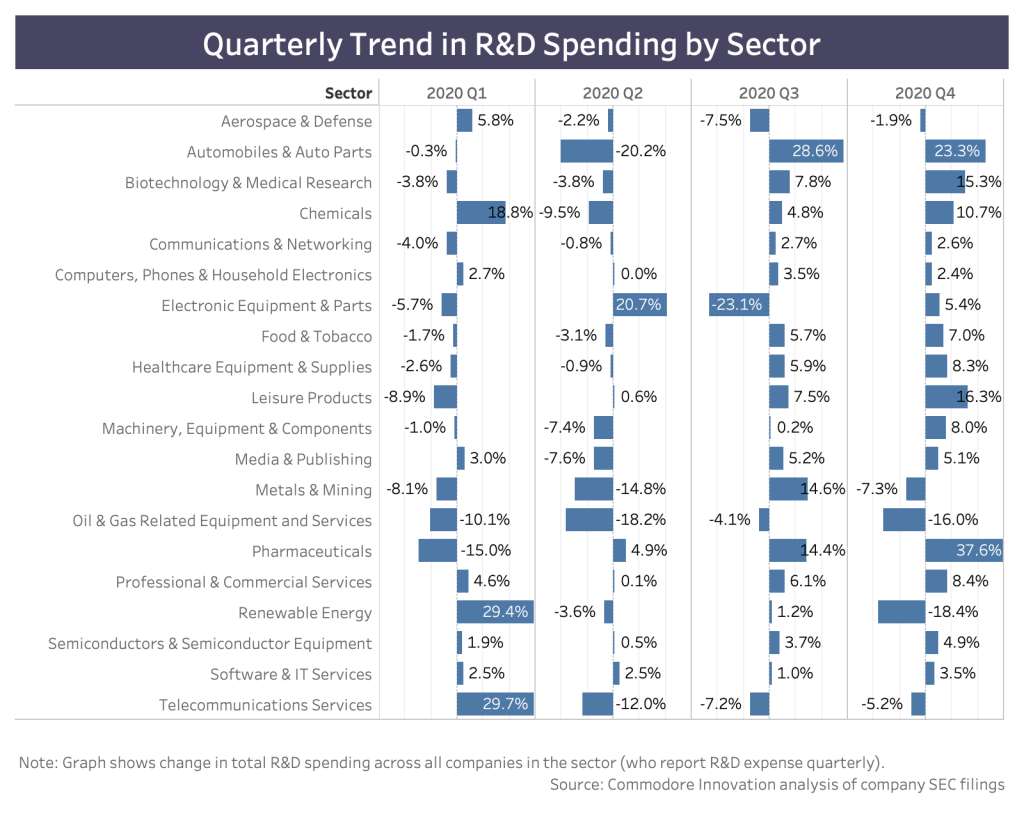
On the other hand, sectors that decreased R&D investment in Q4 included:
- Renewable Energy
- Oil & Gas Related Equipment and Services
- Metals & Mining
- Telecommunication Services
- Aerospace & Defense
At a firm level, seven out of ten of the firms with the largest increase in R&D investment were pharmaceutical or biotech firms. The remaining firms were tech giants Amazon (which is also the largest overall investor in R&D at $12 billion—which they report as “Technology and Content” expense) and Facebook, as well as semiconductor leader Intel.
Posted on April 9, 2021 by Phil Watson
COVID-19: Business R&D Spending Will Fall by at Least 5-6%

In the last few weeks our worlds have been turned upside down. As individuals we are grappling with the fear, disruption and uncertainty brought about by COVID-19. The organizations we work for are scrambling to manage extraordinary challenges. In some sectors, the threat is unquestionably existential. For almost all it is likely unprecedented.
Innovation teams are not, of course, immune to this disruption. There are immediate challenges and opportunities—and longer-term challenges loom large.
This post explores historic trends in business R&D investment during recessions. If you’re interested in how companies are adjusting future spending plans for the remainder of 2020, sign up below for further information about our forthcoming benchmarking report.
Innovation should be part of the immediate response
In the immediate term, innovation teams have opportunities to stay relevant by helping their organizations respond effectively to the new environment in which we find ourselves. That might be in relatively small ways like sharing and disseminating knowledge about tools and behaviors that enhance virtual / remote collaboration. And it might be larger ways such as helping to drive or facilitate innovation processes that identify ways your organization can help our communities and our governments (e.g. a hackathon for an open source ventilator).
Longer-term implications for innovation
Innovation leaders will also need to turn their attention to longer-term questions. Recession is looking increasingly likely in many countries. In the US, current baseline or central forecasts suggest a very steep Q2 decline in GDP (-7% annualized), followed by zero growth in Q3 and a return to positive territory in Q3 (+2.6%). It is, therefore, likely that innovation teams will face budget pressure. To prepare for such challenges, historical experience can be instructive.
In five out of the last six recessions the United States has gone through since 1960, R&D spending (a good proxy for total innovation investment) by firms has declined. For example:
- Early 2000s recession: R&D spending fell by 0.9% in 2001 and a further 5.6% in 2002.
- Great Recession (late-2007 to mid-2009): R&D spending didn’t decline until 2009 (by 5.2%), but the decline continued into 2010 (0.4%).
While neither recession is entirely analogous to economists’ current forecasts, they still suggest innovation leaders should anticipate pressure to cut innovation budgets by at least 5-6% over the next 12-18 months. Obviously, this is based on an average impact across all sectors of the US economy—some firms will face pressure for much greater cuts.

Prepare for innovation budget pressure now
It is imperative that innovation leaders start preparing for budget conversations now. To do that, we recommend preparing to:
- Demonstrate the value of innovation to the organization.
- Run leaner.
- Gather benchmarking data.
Demonstrate value
Now more than ever it’s critical your key stakeholders across the organization understand the value innovation brings. Ideally you already have a comprehensive set of innovation metrics that help you demonstrate your innovation team’s return on investment. To check you’re measuring what you need to check your metrics against our measurement framework or take our self-assessment. If you’re not measuring what you need to, now is the time to quickly assemble that data.
The quantitative information provided by metrics should be complemented by stories that make your team’s value and relevance real. Given the current context, these stories could include examples of how your innovation team is supporting your organization’s immediate response to the COVID-19 crisis. And how innovation helped your organization recover from prior recessions.
Prepare to run leaner
Most innovation teams are likely to face significant cuts. That means you need to start preparing to run leaner—now. Again, innovation metrics can help. If you have a comprehensive innovation performance measurement system in place, it will provide you with the insight necessary to know how to run leaner. For example, it will tell you which projects and portfolios deliver higher RoI. And it will highlight areas of your innovation process that could be more efficient.
If you don’t have the insight necessary to inform those decisions, it’s not too late to assemble it. The alternative is to fly blind.
Gather benchmarking data
When setting budgets for innovation / R&D many firms want to understand how their investment levels compare with their competitors’. R&D as a percent of revenue is a common, if somewhat flawed, benchmark. Such insight will be an important input into forthcoming discussions about future funding levels. In some ways it’s more important than ever to understand what your competitors will be doing. If your company cuts innovation spending, but a competitor doesn’t, will you lose your technology leadership position?
Forward-looking benchmarking data on R&D spending is not readily available. Commodore is preparing a benchmarking report analyzing innovation / R&D spending plans for the remainder of 2020. If you are interested in sharing data and receiving the report, sign up below to receive further information.
Forthcoming Report: Benchmarking Innovation Investment post COVID-19
Complete the form below to receive further information about Commodore Innovation’s forthcoming (free) report benchmarking innovation spend plans for the next 12 months.
Posted on March 23, 2020 by Phil Watson
Communication is Job 1 of your innovation measurement system

I heard an innovation leader at a Fortune 100 company remark recently, “There are lots of jobless innovation managers out there who will tell you—’if I knew then what I know now, I would have communicated better.’”
Posted on August 7, 2018 by Adrienne Brown
How to Measure Your Innovation Project: A Guide

Since starting Commodore a few months ago, we’ve talked with dozens of innovation practitioners who know how important it is to measure performance, but …! But they’re not sure how to get started. But they’re not sure how to make the case for investing time to measure. But they already have a system … but it doesn’t seem to be useful.
So we wanted to help. We created a step-by-step guide that’ll work whether you’re starting from scratch, or you have a system in place that needs a tune-up.
Posted on August 1, 2018 by Adrienne Brown
Measuring Innovation Performance — A Better Framework

A lot has been written about measuring innovation in recent years. I’ve been reviewing this literature as we build our service offering for Commodore Innovation. (For anyone interested, we have a live list of resources related to measurement of innovation here). Many of the articles, blog posts, surveys of industry practice, etc. suggest frameworks for measuring innovation. That is, they propose a way of thinking about what companies should measure when it comes to tracking innovation. Done well, such frameworks become tools that enable companies to quickly review and enhance their innovation measurement systems or establish entirely new systems. The existing frameworks available fail to achieve that objective, for reasons I describe below.
Existing frameworks for measuring innovation performance conflate innovation performance and innovation capabilities.
Many frameworks fail because they attempt to describe two quite different things, without drawing the distinction:
- Measuring the performance of an innovation function (as measured by metrics like number of ideas generated, or percent of revenue from new products / services introduced in the last 3 years).
- Assessing a firm’s innovation capabilities (e.g. share of employees have been trained in certain innovation methods, number of incentive schemes supporting innovation)
These are two fundamentally different things. Commodore Innovation is focused on measuring the performance of an innovation function, so that’s where this blog post will focus. I’m not suggesting you should ignore innovation capabilities. But we do believe it’s critical to be able to measure the performance of your innovation function first. Otherwise, how will you know any attempt to improve your capabilities was successful? Sure, you can count the number of design thinking workshops you’ve conducted. Or even measure the adoption of design thinking practices by your team. But did that investment have any positive outcomes for your business?
Some frameworks include categories of innovation metrics that lack clear definition.
Looking at the dozens of categories of metrics defined or recommended in the literature, it’s easy to see how some companies end up with cluttered dashboards. Of these, we think inputs, outputs, and outcomes are critical. Not all sources use these exact labels. Definitions vary and are sometimes confusing. We like the following definitions, based on a report by the National Academy of Science:
- Inputs: measures of tangible quantities put into your innovation process to enable you to achieve your innovation goals.
- Outputs: measures of the things your innovation process has produced – which may be a “finished” product or service ready to go to market and interim outputs such as a new idea, proof of concept prototype, etc.
- Outcomes: measures of results that stem from use of the outputs of your innovation process.
Other common categories (that don’t quite make my cut as “critical”) include the following.
- Impact – measures of the broader socio-economic consequences of an outcome from your innovation process. Measuring impact may be important in certain situations, like for a social impact incubator.
- Activity – Measures of activity (e.g., number of ideas submitted by employees) are generally measures of output or interim output so don’t merit a separate category. Also, it’s common for companies to get stuck measuring only activity.
- Processes – Measures of the course of action to achieve innovation goals (e.g., an effective project review process) seem to be largely about assessing innovation capabilities. As explained above, we think it’s best to focus on performance first.
- Portfolio – e.g., the share of investment by stage of development (such as breakthrough projects versus product line extensions). Looking at the portfolio is extremely valuable, but it is not a separate category of measurement. Instead, it’s one of the levels at which you can drill down if you have a nesting measurement system (more on this in our next blog post).
Many frameworks stop short of recommending what aspects of innovation performance measure.
An input/output/outcome framework is attractive in its simplicity. But at this point in my review, I realized I saw very little guidance on what companies should measure within these large buckets. After all, you could easily satisfy the condition of measuring “outputs” but fail to measure aspects of innovation performance that are critical. Within outputs, for example, a firm could track number of patents granted, but know nothing about the expected commercial value of those patents.
To learn more, I reviewed around 150 innovation metrics used by companies today. Clustering these metrics by theme reveals the questions firms are trying to answer when measuring innovation outputs and outcomes:
- Value: Are the firm’s innovation projects creating value (or future value)? For example, are they creating future new revenue opportunities, de-risking innovation initiatives or enabling cost savings through business process improvements?
- Learning: Are the firm’s innovation projects making progress in a way that is unlocking future value?
- Strategy: Are the firm’s innovative projects aligned with strategy? For example, does the portfolio of innovation activities achieve the target spread across innovation “horizons”?
- Efficiency: Are the resources utilized by the innovation function being efficiently used to create future value?
- Speed: Are the firm’s innovation projects moving quickly enough?
Think these questions aren’t rocket science? Good! I hoped not. But, if you can succinctly answer these questions (with both quantitative metrics and qualitative insight), then you’re providing your organization with the information it needs. If the answers are “good” then you’re well positioned to demonstrate how well you’re performing. If the answers are “bad” then you’ll know where to focus to get to “good.”
The diagram below (click to download a PDF version) maps these questions to the input / output / outcome framing. A good measurement system should answer all ten of the questions here. That said, the metrics themselves and their relative importance will vary depending on your specific context (and over time). The metrics in the diagram are illustrative only. We’ll have more to say on how to choose the right metrics for your organization in the future.

Hopefully this framework provides a more useful resource if you’re trying to establish or review your innovation measurement systems. But keep in mind there’s more to a measurement system than the metrics. You also need a way to measure at different levels of the organization (e.g., project, business unit, portfolio). You need to consider how to communicate your metrics (think: your reporting cadence, adding qualitative insight). Visit our Resources page for further guidance on these topics, including our step-by-step guide to measuring innovation performance at a project level.
Download our Innovation Performance Measurement Framework
Reference:
National Academy of Science, (2005). Thinking Strategically: The Appropriate Use of Metrics for the Climate Change Science Program. The National Academies Press, Washington, D.C. (link)
Posted on July 6, 2018 by Phil Watson
Companies struggle to measure well at the front end of innovation

We think companies can measure better all along the innovation pipeline, but if you asked us what sorts of activities need the most improvement vis-à-vis measurement? It’s not even close: it’s at the front end.
Posted on June 12, 2018 by Adrienne Brown
Why ‘Dead Reckoning’?

We thought we’d better go ahead and address this one right up front. What is “dead reckoning” and why on earth would we pick that as the name of our blog?
Posted on May 4, 2018 by Adrienne Brown
More efficient innovation may be critical to staying competitive

One of the reasons we started Commodore was concern about a decline in Total Factor Productivity (TFP) in many major economies (e.g., US, China, the euro area). TFP is, put simply, the portion of economic growth that occurs from using either labor or capital more efficiently—in some ways it’s a measure of innovation within an economy. (A certain Commodore founder, who shall remain nameless, has been a bit of an economics geek ever since he watched Mr Hyslop furiously describe price elasticity of demand on a dusty chalkboard in Fifth Form Economics.)
Posted on May 1, 2018 by Phil Watson
Why is everyone dissatisfied with innovation?

Over the last ten years—both in my practice as an innovation consultant and in the literature—I’ve seen a recurring theme among people responsible for growth in large companies. Consistently, they rank innovation among their highest priorities and consistently, they’re not happy with how it’s going.
Why aren’t they happy? Of course it varies by person and by company, but these are among the reasons I hear most often:
Business leaders aren’t satisfied with the return on their investment in innovation.
As far back as 2008 57% of the 3,000 executives BCG surveyed about innovation said they were dissatisfied with the financial return on their investment in innovation. The 2017 issue of that same survey showed 76 percent of respondents that identify their companies as “weak” in innovation are dissatisfied with return on innovation spending. This is perhaps not surprising given an increasing number of studies shows that innovation performance is declining. (See our post on this topic).
Innovation leaders aren’t confident in the decisions they’re making.
Sixty-five percent of senior executives that responded to a McKinsey survey said they were somewhere between “somewhat” and “not at all” confident in the decisions they make related to innovation. I’ve seen the downstream effects of this lack of decisiveness. One director of R&D for a consumer products company told me his team was stretched too thin because they didn’t have a basis for saying “no” to ideas so they kept working on everything.
Expectations aren’t aligned across levels of the firm.
The perspectives of business leaders don’t line up with those of the people on the front lines of innovation. A client with 20 years of experience developing new ventures in a large firm told me, “I know in my heart that the mismatch between leadership’s perceptions and mine is our biggest problem.” Another said “I’ve exhausted myself trying to get on the same page with my CEO.” (I wrote more about this here.)
TL/DR: expectations aren’t being met; decisions are being second-guessed; resources are being wasted; and teams aren’t on the same page. I only pretend to be a therapist, but that seems like a recipe for unhappiness.
High-quality measurement is part of the solution.
Under those circumstances in other corporate functions, you might take a hard look at metrics, but that’s often not the case with innovation. You might say that’s because your measurement system doesn’t tell the real story, or that you de-emphasize measurement because it’s better to fly under the radar. Maybe you’ve had bad experiences with metrics designed for the rest of the organization. It’s true—those don’t work well in the innovation context, where you need to account for uncertainty and ambiguity; and emphasize learning and communication.
But, if the problems above sound familiar, it’s worth examining: might better measurement be part of the solution?
Posted on April 24, 2018 by Adrienne Brown
The way we measure innovation hasn’t changed in 10 years.

The way companies measure innovation initiatives is outdated. Despite all the progress that has been made in innovation practice in the last decade, firms are still measuring innovation in much the same way. And let’s not forget that what gets measured gets done (with apologies to Drucker, Lord Kelvin, Rheticus or whoever the original source was).
Companies are using the same old metrics.
Take a look back at surveys on innovation practice that were done in 2008 — here’s one by BCG, and another by McKinsey. The most frequently used metrics include:
- Percentage of sales from new products or services
- Overall revenue growth
- Number of new products or services
- Return on innovation spending.
Fast forward to more recent surveys (e.g., by Innosight & Innovation Leader) and almost exactly the same metrics show up on the leaderboards. For example, the top ranked metric in the IL survey was “revenue generated from innovation projects” — which captures the same insight as the first two metrics from the earlier surveys shown above. Another popular metric in the IL survey was “internal rate of return” — essentially equivalent to “return on innovation spending.” While “number of new products and services” didn’t explicitly show up in the IL survey, firms still take the same simple activity-based approach, just earlier in the pipeline (e.g. number of projects in the pipeline, number of ideas generated).
It’s not that these are necessarily bad metrics. For example, as an impact metric, “percentage of sales from new products or services” meets several key tests:
- It’s likely to align strongly with senior management’s objectives for their investments in innovation.
- It’s clear and easy to communicate.
- It’s (relatively) straightforward to collect the data necessary to calculate the metric.
I guess it’s possible that metrics haven’t changed simply because everyone is happy with the metrics they have—they get all the information they need from them. But that doesn’t resonate with our experience, and everyone sure seems dissatisfied with innovation.
Innovation performance measurement is more than metrics.
Conversations about innovation measurement often start and stop with the topic above—which metrics are best? That’s another way innovation measurement—and I would argue, innovation performance—is stuck. With rare exceptions, companies haven’t gotten more sophisticated with measurement practices in the last 10 years, either. If they had, I’d expect to see more high-quality measurement systems that:
- Are elegant. An up-to-date measurement system would be clear as to purpose and streamlined to collect only metrics that are used to make decisions.
- Enable benchmarking. Cutting-edge innovation measurement would enable comparison of performance, internally (e.g., across business units, over time) and externally.
- Are built for communication. Where outdated systems are built only for reporting status “up,” high-quality systems help project teams make decisions and build understanding and commitment among stakeholders.
- Align with decision-making culture. Effective measurement systems align communication with the way decisions are made in your company.
- Are effective for diverse portfolios. High-quality measurement systems handle hard-to-measure front end and “disruptive” projects, not just routine new product development projects.
- Measure the impact of changes. A cutting-edge system would be able to quantify the impact of changes to processes and tools, and innovation culture initiatives, on outcomes.
Measurement hasn't kept up with the evolution of innovation practices.
What’s particularly striking about the lack of change in metrics is that innovation practices have evolved significantly in recent years. Take, for example, the use of tools and methods like human-centered design, Lean Startup, and agile innovation. In many ways adoption of these practices marks a significant moment in the maturity of innovation management as a function. No longer are innovation professionals forced to adapt ill-suited tools and methods that were developed for parts of the business that focus on execution. Now they have at their disposal techniques specifically developed to address the challenges unique to innovation initiatives. Many of these techniques create the opportunity to measure innovation initiatives in more effective ways — ways that more accurately reflect whether an initiative is successful and likely to deliver value for the organization.
Innovation practices are evolving. It’s time the ways we measure innovation did too.
Posted on April 20, 2018 by Phil Watson